Straight answerBees are hairy, collect pollen and build wax nests. Wasps are smooth and shiny, chew wood into paper nests, and can sting more than once. A clump of bees hanging from a branch or fence is a honey bee swarm: call a beekeeper, who will usually collect it for free. Bumblebee nests are normally left alone. Wasp nests near the house are a pest job.
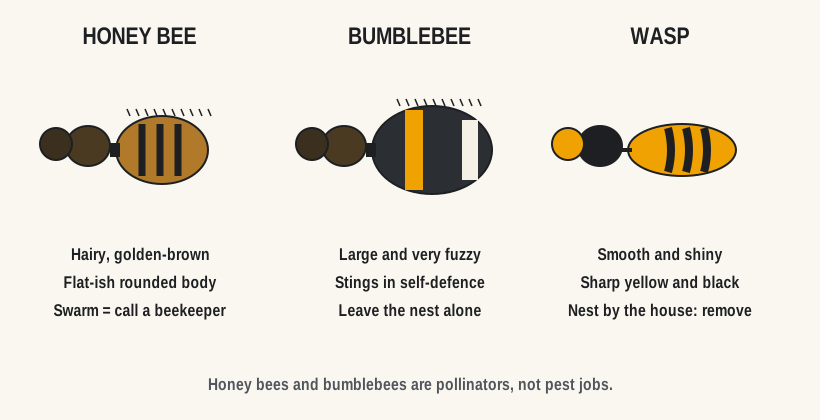
The differences at a glance
Landcare Research sums it up: bees collect pollen, store food and make honey, while wasps do none of these. Bees build with wax, wasps with paper. Bees lap up liquids, wasps chew. A honey bee can sting only once and leaves its sting in your skin. A wasp keeps its sting and can use it again.
| Honey bee | Bumblebee | German wasp | Paper wasp | |
|---|---|---|---|---|
| Body | Hairy, golden-brown, about 12 mm | Large and fuzzy, up to 25 mm | Smooth, bright black and yellow | Slim, brownish with yellow rings |
| Nest | Wax comb in a hive, hollow or wall | Underground | Covered paper ball, often hidden | Open paper comb on a stalk |
| Stings | Once, sting stays in | In self-defence | Repeatedly | Repeatedly |
| Who to call | Beekeeper (swarm collector) | Usually no one | Pest controller | Pest controller if near people |
Found a swarm of bees?
A swarm is a queen and roughly 5,000 to 20,000 workers looking for a new home. It often hangs in a cluster on a branch, fence or letterbox. Honey and Bees New Zealand says leave it alone, don't spray it, and call a trained swarm collector. Swarming bees are not aggressive unless provoked, and collection is usually free.
- Swarm season runs from about August to January
- Use the regional swarm collector list from Honey and Bees New Zealand
- In Auckland, the Auckland Beekeepers Club runs a free volunteer swarm service
- Tell them the address, where the swarm is, how high and how big
Bees already inside a wall or roof
Once a swarm moves into a building it is no longer a swarm, and club volunteers usually can't collect it. You will likely need a beekeeper who does cut-outs, sometimes with a builder. Killing the bees and leaving the comb in the wall can cause problems later, because the honey can leak and draw in other insects and robbing bees.
Bumblebee nest in the garden
Bumblebees are large and fuzzy, up to 25 millimetres, and nest underground. New Zealand has four introduced species, brought in to pollinate red clover. They sting only to defend themselves. Beekeepers don't generally remove bumblebee nests, and most people leave them for the season.
When it is wasps
If the insects are smooth, bright black and yellow, and streaming in and out of a hole, a wall gap or a papery nest, it is wasps. German wasp nests near people should be treated. Paper wasp combs by doors and paths too. How wasp nest removal works.
Questions people ask
Do you have to pay to get rid of a bee swarm?
Usually not. Honey and Bees New Zealand says swarm collection by its trained collectors is usually free, and in Auckland the Auckland Beekeepers Club runs a free volunteer service for swarms out in the open. Bees that have already moved into a wall or roof are a different job and usually need a paid specialist.
Should I spray a bee swarm?
No. Honey and Bees New Zealand asks people not to spray swarms with insecticide. A swarm is usually calm and moves on or gets collected, and honey bees are important pollinators. Keep people and pets back and call a swarm collector instead.
Do bumblebees sting?
They can, but Landcare Research notes they sting only in self-defence. Most stings happen when someone grabs one or disturbs the nest. Beekeepers don't generally remove bumblebee nests, so most are left for the season.
What is more aggressive, a wasp or a bee?
Near the nest, German wasps. A disturbed German wasp nest sends out alarm signals and workers attack anything moving within about 7 metres, and they can sting repeatedly. Honey bees defend their hive too, but a swarm away from its hive is usually calm.
Sources we checked
- Wasp FAQ (Manaaki Whenua Landcare Research)
- Honey bee (Manaaki Whenua Landcare Research)
- Bumble bee (Manaaki Whenua Landcare Research)
- Swarm collection (Honey and Bees New Zealand)
- FAQ (Honey and Bees New Zealand)
- Report a swarm (Auckland Beekeepers Club)
Last reviewed 2026-10-06.